
Infrastructure Planning – Guidance for Communities
Introduction
Welsh Government has provided additional grant support to Planning Aid Wales to help communities understand and engage with the new Infrastructure planning regime that came into force on 15th December 2025.
Guidance and training on Infrastructure Planning for Communities is available below.

Overview
The Infrastructure (Wales) Act 2024 creates a national system for deciding large infrastructure projects in Wales.
Large scale energy, transport, water and waste projects that meet certain thresholds become Significant Infrastructure Projects (SIPs) and, instead of going through the usual local planning process, they are examined by Planning and Environment Decisions Wales (PEDW).
Following examination, decisions are made by Welsh Ministers, and if approved, permission is granted through an Infrastructure Consent Order (ICO). The process is designed to be structured and evidence-led, with opportunities for communities to engage at key stages.
Welsh Government Guidance on Significant Infrastructure Projects can be viewed here.Roundtable Session
On 12th February 2026, Planning Aid Wales hosted an online roundtable discussion called Infrastructure Planning: Community Perspectives. A mixed audience including county councillors, community and town council representatives, and private sector and NGO stakeholders discussed their experiences of infrastructure development.
The findings of the discussions are available in the event report above (click on the image to download the report).
Training Course
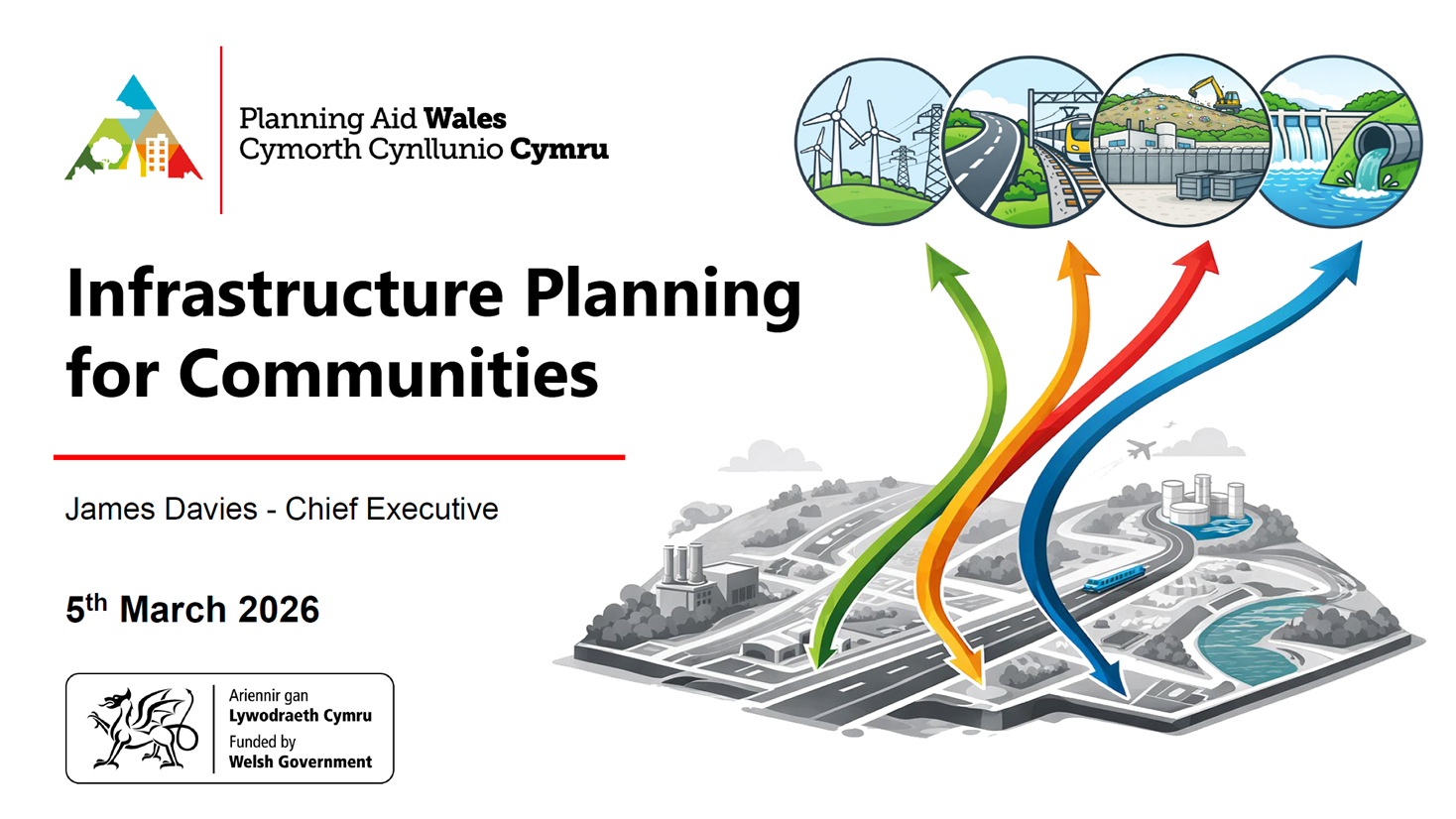
In March 2026, Planning Aid Wales delivered two detailed training courses on Infrastructure Planning for Communities. The sessions covered the key stages of the process, including pre-application consultation, examination, and decision-making, alongside the roles of different bodies such as PEDW and Welsh Ministers. Particular emphasis was placed on how community and town councils can understand technical documentation and respond meaningfully to major infrastructure proposals. To download the course, click on the image above.
Contact Us
If you have any specific questions relating to how infrastructure planning works or suggestions for our new guidance we would love to hear from you – please drop us a message below.
Consultation & Engagement in Infrastructure Planning
The full application is submitted to Planning and Environment Decisions Wales, including all required supporting documents such as environmental information and a Pre-Application Consultation Report, which demonstrates how pre-application consultation has been carried out and how feedback has influenced the proposal.
Pre-application Notification
This initial stage formally signals that a developer intends to bring forward a major infrastructure proposal, giving early notice to stakeholders and setting the groundwork for engagement before detailed plans are finalised.
Pre-application Consultation
The developer is required to consult with communities, local authorities and statutory consultees on their emerging proposals, providing an opportunity to influence the scheme at a formative stage before submission. This must be for a minimum period of 42 days.
Submission of Application
The full application is submitted to Planning and Environment Decisions Wales, including all required supporting documents such as environmental information and a Pre-Application Consultation Report, which demonstrates how pre-application consultation has been carried out and how feedback has influenced the proposal.
Consultation and Request for Local Impact Report
Once the application is accepted, formal consultation takes place and a Section 34 notice is issued inviting representations. The Local Planning Authority is required to submit a Local Impact Report (LIR), setting out the likely effects of the proposal on the area, while Town and Community Councils may also submit an LIR on a discretionary basis.
Further Issues to Consider by Inspector
The appointed Inspector reviews the application and consultation responses, identifying any additional matters that require further clarification or examination.
Examination
A structured examination process takes place, led by an Inspector, where evidence is considered through written submissions, open-floor hearings, or a formal inquiry.
Decision by Welsh Ministers
Following examination and the Inspector’s recommendations, Welsh Ministers make the final decision on whether to grant or refuse consent. The decision must be made within 52 weeks of the date of submission of the application.
Infrastructure Planning Glossary
Application (Infrastructure Consent)
A formal request for permission to carry out a Significant Infrastructure Project. It includes plans, environmental information, consultation reports and a draft Infrastructure Consent Order.
Compulsory Acquisition
The legal process that allows land to be acquired without the owner’s agreement, where it is necessary for a project and properly justified. It is authorised as part of the Infrastructure Consent Order.
Consultation
Asking people or organisations what they think about something. Comments are usually asked for on a particular matter (such as a planning application), or a set of issues, or a draft document (such as public participation in preparing a plan). Consultation can be formal or informal.
Consultation Report
A document submitted with an application explaining who was consulted, what issues were raised and how the proposal was changed in response.
Cumulative Impact
The combined effect of a project when added to other existing or planned developments in the area.
Development
Defined in planning as ‘the carrying out of building, engineering, mining or other operations, in, on, over or under land, or the making of any material change in the use of any building or other land.’
Development Plan
The document which sets out planning policies and proposals for future development in an area. It is the ‘primary material consideration’ or most important factor in deciding planning applications.
Environmental Impact Assessment (EIA)
A process used to identify and assess the environmental effects of a project before a decision is made.
Environmental Statement
A detailed report submitted with an application that sets out the findings of the Environmental Impact Assessment, including impacts and mitigation.
Examination
The formal stage where the application is tested by an independent inspector. Evidence is reviewed, questions are asked, and written or oral representations are considered.
Examination Timetable
A fixed programme set at the start of examination which defines deadlines for submissions, hearings and decisions.
High Court (Judicial Review)
The process by which a decision can be challenged on legal grounds. It looks at whether the decision was made correctly, not whether it was right or wrong.
Infrastructure Consent Order (ICO)
The legal permission granted for a Significant Infrastructure Project. It can include planning permission, compulsory acquisition powers and other necessary consents in a single decision.
Infrastructure (Wales) Act 2024
The law that introduced a new system for deciding major infrastructure projects in Wales, with decisions made at a national level.
Interested Party
Any person or organisation who has made a formal representation and is involved in the examination process.
Local Development Plan (LDP)
The development plan, or planning policy document for a local authority area, setting out where and how development should take place over a 15-year period.
Local Impact Report (LIR)
A report prepared by a local authority (and optionally community councils) describing how a proposed project would affect the local area, including policy context and local evidence.
Material Consideration
If something is material, it is relevant to planning and needs to be taken into account before a decision is made. Whether or not something is material often depends on the individual case.
Mitigation
Measures included within a proposal to reduce or manage negative impacts, such as environmental, visual or traffic effects.
National Policy (Future Wales / Planning Policy Wales)
Planning policy set at a national level which guides decisions on infrastructure and development across Wales.
Open-Floor Hearing
A structured but informal session during examination where members of the public can speak directly to the inspector about the proposal.
PEDW (Planning and Environment Decisions Wales)
The organisation responsible for managing the examination of infrastructure applications and appointing inspectors.
Pre-Application Consultation
A required stage before an application is submitted, where developers must consult communities, local authorities and statutory consultees on their proposals. For SIPs, the pre-application consultation is a minimum period of 42 days.
Representation
Comments which are submitted to a local planning authority. They can either be in support of something, or they can object to something.
Section 34 Notice
A formal notice issued after an application is accepted, inviting representations and setting deadlines for participation in the examination.
Significant Infrastructure Project (SIP)
A type of development defined in law which is considered significant enough to require a national decision-making process.
SIPs typically include major energy, transport, water and waste projects. A project becomes a SIP if it:
• meets specific thresholds (such as capacity, length or volume); or
• is directed to be treated as a SIP by Welsh Ministers.
Examples include:
• Energy – electricity generating stations between 50–350 megawatts (MW), including onshore wind farms of 50 MW or more
• Overhead electricity lines – 132 kilovolts (kV) and at least 2 km in length
• Transport – new highways of 1 km or more (where Welsh Ministers are the highway authority), or new railway track of 2 km or more
• Water – reservoirs of 10 million cubic metres, or water transfer schemes of 100 million cubic metres per year
• Waste water – treatment plants serving 500,000 people or more, or storage of 350,000 cubic metres
• Waste – landfill or disposal facilities handling 100,000 tonnes per year, or hazardous waste facilities handling 30,000 tonnes per year
Instead of being decided by a Local Planning Authority, SIPs are:
• examined by PEDW
• decided by Welsh Ministers
The process includes formal consultation, examination and the submission of evidence by local authorities, communities and statutory consultees.
Statutory Consultee
An organisation that must be formally consulted because of its responsibilities (for example Natural Resources Wales).
Threshold
The size or scale at which a project becomes a Significant Infrastructure Project and must follow the national process.
Validation
The stage where an application is checked to make sure it includes all required documents before it is accepted.
Welsh Ministers
The decision-makers for Significant Infrastructure Projects in Wales, following examination of the application.